Tomatoes.

 I used to try to grow tomatoes. However, they require attention and care, something that falls by the wayside when you're trying to grow a business.

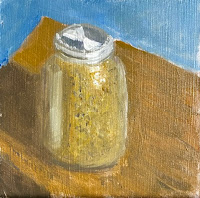
6x6, oil on badly primed board

Luckily, I married a gardener. He took over the whole tomato growing enterprise this year and I was flush with them. I had tomatoes every day. It was heaven.

This is the last tomato from this year's crop.  It popped out late in the season and I picked it this morning and quartered it.  

I had some misgivings about painting tomatoes on an orange plate, but it turned out to be a fun exercise.  

Tiny daily painting.

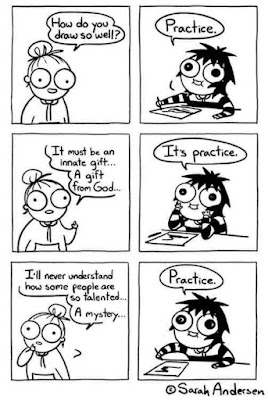
 I admit to a tiny bit of hero worship to this guy. His tiny paintings of the mundane, ordinary things in life are a wonder to behold.  He had a daily habit of painting a small painting and his rendering are amazing. The daily painting movement is designed to do this, to increase skill in rendering and painting. There are other movements as well, such as daily drawing, etc. 

As a science-y type person, I have also wondered,

(c) Sarah Anderson
if I painted a little painting from start to finish every single day, would *I* get better?

I've had people comment things such as, "well as least you have your mother's talent." It's worth noting that actually, I received very little instruction from my mother. In fact, she discouraged me from a career in art, for practical reasons. 

Anders Ericcson says that it is deliberate practice that results in expertise, not innate ability. (You can read more about him here.)

And thus begins the experiment.  

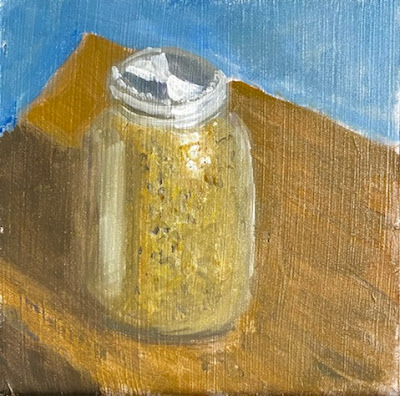
So here is: day 1. I don't know if I'll be able to do this every day, but the challenge is to take some ordinary thing and paint it onto a 6x6 panel. I expect Mondays and Tuesdays are off the table, because I go to my office all day. Sundays I either play golf or go to a plein air meetup.  But the rest of the time is up for grabs.  

So, I grabbed a jar of chamomile tea, plunked it down on my tabouret, and began my journey. From start to finish, this took about 40 minutes. 


Of course, I can never leave something alone - it's one of my failings, the ability to walk away, so I poked at the painting for a while.
 I think I liked it better the way it was. Another lesson learned. 

...


In Which I Begin to Paint Outdoors

 Plein air painting has a lot in common with backpacking and painting. 

In the beginning, you pack way too much stuff.  After hauling it around and struggling you finally sit down on your kitchen floor, unpack your gear, and start tossing things aside, "I don't need this--at least not enough to mess with it or carry it any distance.

Still, I've been intrigued with developing this type of painting. I happen to live in one of the most visually and structurally interesting and pleasing areas in the US: New Mexico. Within a day's drive there is desert, mesas, rivers, forests, mountains.  I have a history of long-distance trail-running so being in the wilderness doesn't scare me. 

I signed up for a plein air workshop through the New Mexico Art League. We have gone to three different locations so far.

The first location was Placetas, New Mexico.

I didn't really feel like I had a good view of the Mtn, and I wasn't inspired by the dotted houses on the hillside near me.  However, I was inspired by weird and crazy tree nearby.  I painted it on a gesso masonite board toned with transparent yellow oxide.  


Not over the moon about the mountain in the background. But it is what it is.  


The second location was in Bernalillo, New Mexico.  And I want to take a moment here to introduce my pleinair set-up

My set-up is the oil package from PleinAir Pro. And yes, I KNOW, I KNOW, FRENCH POCHADE BOXES are the thing but I want to be able to paint without fiddling with a million wingnuts.

I use a SLIK tripod - it's pretty great, and I love having the built-in bubble level to steady the legs. Then I slip on a panel holder, which clicks into place, and then the palette. My palette is glass.  I'm just not organized enough yet to use anything else, because I forget to clean it and then need a razor knife.  

The outfit is complete with a sport-umbrella that clamps on. 

The whole thing goes into a large bag that functions as a backpack, and NO, it was not cheap. But totally worth it.   


One of the best tips I've gotten about landscape painting is to make my distant mountains with a mixture of cobalt - this gives them the luminosity they deserve. I generally start with a sky that's a mixture of cobalt and titanium white, which you can totally do in the southwest. In the east, I think you need more prussian blue. 
Then I block in the mountain as being a darker version of the sky. 


The finished painting:


The third location was up near the ski area on Sandia Mountain. I missed this class due to having a pinched nerve, so in the middle of the week, I packed up my gear, and drove up the mountain.

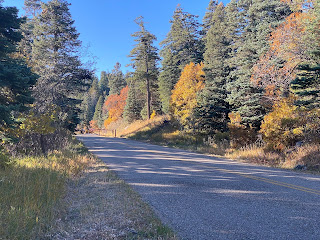
I wasn't over the moon about the location. I prefer big views. But I'm determined to find beauty and interest wherever I go. So here's the scene I picked.


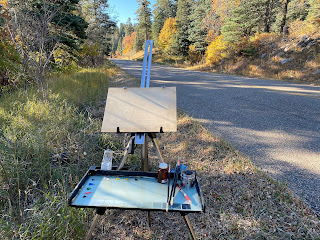
My gear set up, ready for painting.


The beginning. ProTip: I take off my glasses and just paint blobs and shapes as experienced by my near-sighted eyes.  


Here's the painting I left the mountain with in my PanelPak: 

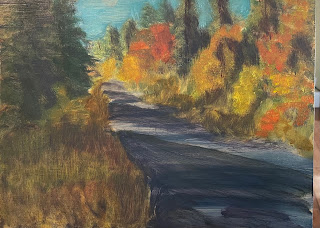
Current situation. Of course it's not done. I'll go back and forth and agonize over everything until I finally give up and put some vanish on it.
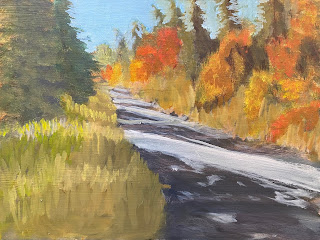


I'm rarely satisfied. I felt like the first pass was too dark and didn't accurately depict the brighteness of the morning, or the scraggliness of the trees. 

I do feel that my looser, impressionistic work is better than when I get down with the tiny brushes to fix up every detail. I also feel that plein air gives me more of a chance to exploit that ability, and the ability to be comfortable. I feel that impressionism is where I want to live, if I can just LEAVE THINGS ALONE and stop going into the weeds on every single detail. 

I also joined the New Mexico Plein Air Painters association or group or something that. I'm stoked! I can't wait to start painting more scenes outdoors.  

In which I have a studio without having a studio.

 It behooves me to mention that I no longer have a studio.  I have a house, in which I paint.

This past summer we spent a week in San Francisco in a friend's small apartment. When I got home I was thinking about space, and how one lives in their space.  My "studio" was a small extra bedroom that was darkly lit, and I was forever fiddling with the lights to get them bright enough in there.  Plus, it's also the room where I do Teletherapy, meaning I don't want all my easels and paints and related painting accoutrement in the background. 

So finally I decided, enough. I'm a grownup, with a house. I rarely entertain, so why am I hanging on to that living room? We don't even have a TV in there. 

I have a couple of Adeptus solid-wood flat pack carts, and one has a drop-leaf end. This is my tabouret. The other card holds drawing supplies and drawing pads.  They're both on wheels.  

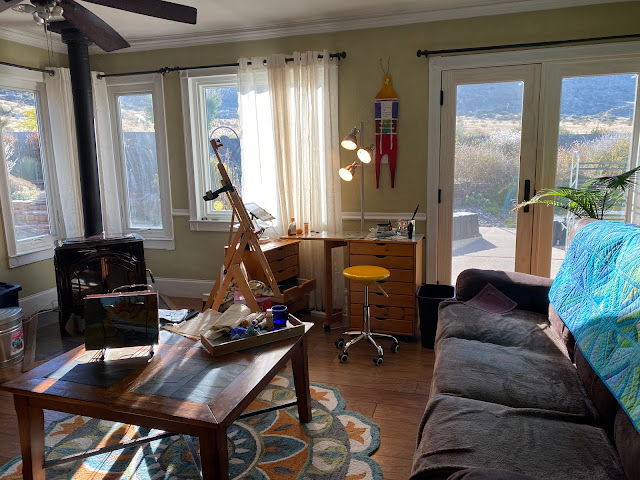
So here is the result:


I presented it to my husband when he came home from drill, "TADAAAAA!" 
He was pleased. "I can sit in here and read while you paint." 

The light-filtering curtains keep the room bright while not overwhelming my spot.

I repurposed an old ipad. It is now my "reference photo". I love it because I can zoom in. However, I would love it more if I could annotate, draw some reference lines on it. 

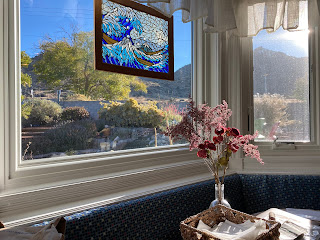
Nearby is my favorite coffee place: my breakfast nook, which looks out over Himself's garden
and the Sandia Foothills.  


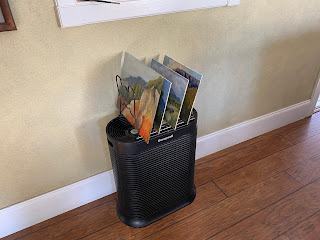
I have two HEPA air cleaners with charcoal pre-filters, and pot lid rack on them from Amazon. 
Newly painted painting rest in them, and this keeps the house from smelling like a oil factory.


Yes, it's an odd fixture in my living room. But it's not like I'm having any major parties in there. 
And if it's a living room, why not live in it?

Other news: I'm toying with "Fine Art America" Yes, it's a tiny bit mercenary. But if it pays for good quality paintbrushes....

...